

Did you know that a more technically efficient pedal stroke will allow you to generate more power (watts) and optimize your energy expenditure? With an optimized pedal stroke, you’ll be able to ride longer while expending less unnecessary energy. Here’s how.
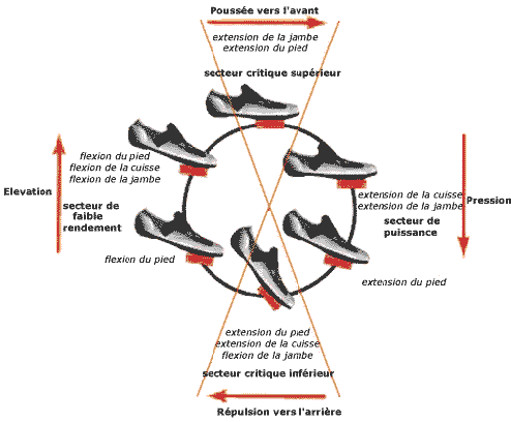
“Round” Pedal method
When pedaling, your motion should be circular instead of up and down. The points to watch for? The two dead spots, that is, the moment when the crank arm is at 0 degrees (fully up) and the moment when it is at 180 degrees (fully down). These are the most problematic points. You should then pull the pedal when your foot is at the bottom (a bit like wiping the tip of your toe on a rug), and push the pedal forward when your foot is at the very top of the crank.
How to train to spin faster
Why is it so important to pedal instead of constantly working on strength? It’s simple: because the cardiovascular system recovers faster than the muscular system.
Velocity exercises, where you aim for a cadence above 100 rpm, will help you progress. On a slight downhill slope, for example, you can practice by pedaling at a high cadence for 1- or 2-minute segments. A cadence computer is obviously essential for velocity training. Visit our store: Ski Vélo Vincent Renaud offers several models.
Optimal cadence
Aside from these workouts, it’s important to adopt a cadence that will optimize your energy expenditure. Target cadences are 75-80 rpm uphill and up to 105-110 rpm on flat or slightly flat descents. An average cadence of 85 rpm during a ride is ideal. With a cadence computer, you can quickly see your average.
Each cyclist’s style also plays a role in determining an optimal cadence. For example, a more muscular cyclist will tend to spin a little slower, while a more slender and endurance-oriented cyclist will spin faster.
Manage your energy with the watt-power
The power meter, or power sensor, is another tool for better managing your efficiency and energy. More expensive than a traditional cyclometer (easily costing over $700), this device displays a constant value over time, unlike heart rate, which fluctuates depending on your level of fatigue, dehydration, outside temperature, and other factors. If you’re an advanced cyclist, a power meter could be very useful. The specialists at Ski Vélo can advise you on which model to choose.
An efficient pedal stroke: watch the pros
A cyclist with an efficient pedal stroke barely moves on their bike: their stabilizing muscles are involved in the movement and, as their name suggests, they ensure perfect core stability while pedaling. Look at the pros during the Tour de France, for example: their pedal stroke is absolutely stunning!
Quick tip provided by the ACE
Gilles Lefebvre, Head Coach at the Académie Cyclisme de l’Estrie (NCCP Level 4 Certification #806547), offers our clients a complete road cycling technique training program: physical and physiological training plan, PAM (or other) test, lactate test, nutritional advice, strength training program, private technique sessions, conferences, clinics, and training camps.


